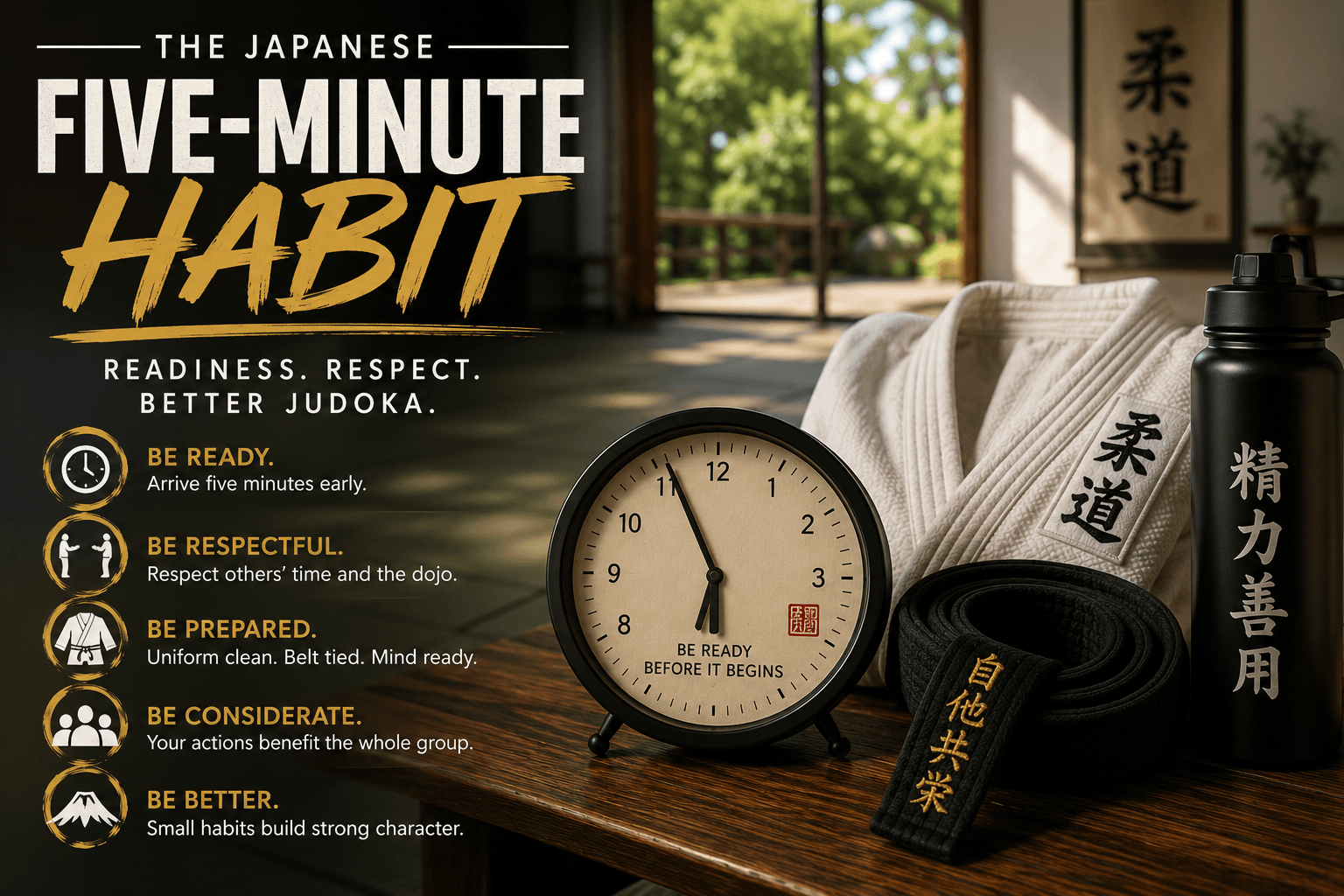
Japanese culture treats punctuality as readiness, not mere arrival. A practical expression for this is gofun-mae kōdō, literally “five-minutes-before action.” If something begins at 6:00, the goal is not to walk in at 6:00. The goal is to have already arrived, completed necessary preparations, and be ready to begin at 6:00.
It is a small distinction with practical weight. For students of Judo, it is a habit worth practicing.
Being On Time Means Being Ready
Imagine class begins at 6:00.
One student enters at exactly 6:00. Belongings still need to be put away. the restroom, a change into the judogi, the belt, a drink of water, and stepping onto the mat all remain. Technically the student arrived at 6:00. They were not ready at 6:00.
Another student arrives a few minutes earlier. Belongings are put away. The judogi is on. The belt is tied. Necessary preparations are finished. At 5:55 they are ready. When class begins, they bow onto the mat with everyone else.
That is the practical meaning of acting five minutes before.
A Lesson in Respect
In Judo we speak often of respect. We bow when entering and leaving the dojo. We bow to instructors and training partners. We keep our uniforms clean and help care for the space.
Respect is not limited to bowing. Respecting other people’s time is also respect.
Arriving prepared communicates without words: your time matters, my classmates’ time matters, our practice matters. Habitual lateness communicates something different, even when unintended.
Judo Begins Before the First Bow
Judo is not practiced only while standing on the mat. It begins with how we prepare ourselves.
Did you remember your uniform? Is it clean? Did you trim your fingernails? Did you bring water? Did you arrive with enough time to prepare? Are you ready to listen when instruction starts?
These habits may appear unrelated to o-soto-gari or escaping a hold-down in newaza. They belong to the same education. Jigoro Kano created Judo as more than a set of techniques. He intended it as a method of physical, intellectual, and moral development. The habits surrounding training matter.
Five Minutes Develops Self-Discipline
For children especially, the habit offers concrete practice in self-discipline and personal responsibility.
Young children rely on parents to arrive on time. As they grow, they can take on more of the work themselves: notice the clock, prepare the uniform ahead of time, fill the water bottle, remind a parent that departure is approaching. Eventually, arriving prepared becomes their responsibility rather than their parents’.
A young judoka who learns this for practice can later apply the same habit to school, work, appointments, and competitions.
Five Minutes Creates Yoyū
Another useful Japanese idea is yoyū: having enough margin or composure that you are not constantly rushing.
Arriving late produces hurry. You search for a belt, tie pants while instructions have already begun, and try to catch up to what everyone else is doing. The body may be in the dojo; the mind has not yet arrived.
Arriving early creates a little yoyū. You put away belongings, straighten the uniform, take a drink, greet classmates, and shift attention from whatever came before class to what is about to begin. When it is time to bow in, you are present.
It Aligns with Seiryoku Zen’yō
One of Judo’s central principles is seiryoku zen’yō, the most efficient use of energy.
Being prepared is efficient. When everyone is ready on time, the instructor does not need to repeat directions. Partners are not left waiting. Warm-ups are not interrupted. Practice time is not lost. Five minutes of preparation before class can protect considerably more than five minutes during class.
It Practices Jita Kyōei
Judo’s other great principle is jita kyōei, mutual welfare and benefit.
Your punctuality does not benefit only you. If the class is pairing up and you are still changing, someone may be left without a partner. If the instructor must stop to bring you current, everyone waits. If you are ready when class begins, the group can train together.
Something as ordinary as arriving five minutes early becomes a practical way to act on the principle: my actions should contribute to the welfare of the group, not merely to my own convenience.
Beyond the Dojo
The greater value is that the habit needs not stay in the dojo.
A young person who develops the practice of arriving prepared, five minutes early for school, practice, a job interview, work, or any commitment where others depend on them, becomes someone others learn they can rely on.
Martial arts education aims at better martial artists. It also aims at capable, disciplined, respectful, and dependable people.
Try It
A simple challenge:
Do not aim to arrive when class starts. Aim to be ready five minutes before class starts.
If Judo begins at 6:00, the goal is straightforward: 5:55 — judogi on, belt tied, water ready, mind ready.
You do not need a promotion, a Japanese vocabulary list, or advanced rank. You need only the decision to be ready five minutes early.
Practice it consistently and it becomes a habit. Sustained long enough, the habit shapes character. That is part of what Judo training is for.


 and
and